


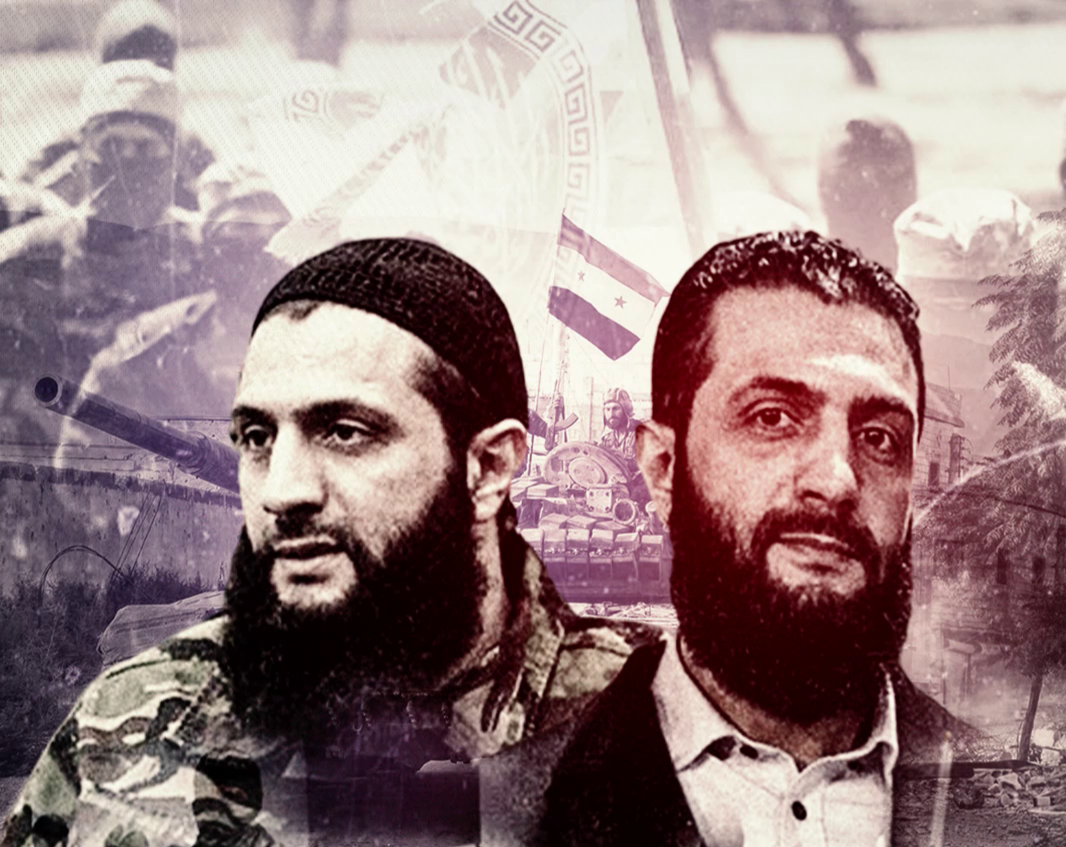
The issue of international recognition of new ruling authorities in crisis-ridden countries has always been a complex arena, intertwined with strategic calculations, geopolitical interests, and media narratives. In Syria, the name Abu Mohammad al-Jolani (Ahmad al-Sharaa) now emerges prominently, as a figure attempting to rebrand himself as a « civil » leader in northern Syria — swapping his turban for semi-modern attire, trimming his beard, smiling more often, and adopting a softer rhetoric. Yet these superficial changes are far from enough to portray Jabhat al-Nusra – now known as Hay’at Tahrir al-Sham – formerly al-Qaeda’s affiliate as a viable democratic alternative for Syria’s future.
1. Changing Appearance Doesn’t Change Essence
Convincing the West or the international community that mere appearance shifts or rhetorical changes justify recognizing a new authority — particularly one that evolved from a jihadist military faction — is not easy. The world still remembers al-Nusra’s record, its slogans, and its former governance style. Thus, presenting Jolani as a moderate leader faces a profound credibility challenge, making recognition a complicated and unlikely outcome.
2. Religious Currents: Tools for Transition, Not Destination
The broader regional context suggests that using religious factions often serves only transitional purposes, not long-term empowerment. These factions are employed as “mine-sweepers”, paving the way for another, Western-approved alternative that is being crafted behind closed doors. Jolani’s current prominence is likely a temporary role in a much larger geopolitical play — one designed to prepare the ground for a more internationally acceptable leadership.
3. The Minority Card: The Ultimate Weapon
Toppling a hardline religious faction from power doesn’t require tanks — just activating the minority card against it. This has been a proven strategy, as witnessed in Mohamed Morsi’s presidency in Egypt, where secularists, religious minorities, and Sufi groups rose against him after his alliance with the Salafis and his attempt to impose an exclusionary vision. Today, growing international warnings about how Jolani’s authority might treat minorities signal the beginning of a campaign to destabilize him from within, under the guise of human rights concerns.
4. Israel and the Minority File: A Gateway for Southern Expansion
The minority issue in Syria is no longer just a question of rights — it has become a geopolitical tool. Israel, which has long used minority narratives for regional influence, is now leveraging the issue to achieve strategic expansion in southern Syria. The recent remarks by Russia’s UN envoy concerning the Alawites in Syria’s coastal region reflect how the “minority file” has become a central axis in shaping the next phase in Syria. International powers are now exploiting the extremist face of Syria’s current de facto rulers to justify interventions and shifts in control.
5. Arab Embrace: A Path to Political Erosion
The case of the Syrian regime’s reintegration into the Arab League offers a cautionary tale. Bashar al-Assad’s regime remained intact during Arab isolation, yet began losing legitimacy the moment it was welcomed back. Jolani must understand that today’s Arab embrace is not necessarily genuine support, but could be a prelude to his political removal — part of a wider regional rearrangement.
6. The Taliban Model: A Warning, Not a Blueprint
The Taliban experience offers a crucial lesson: despite receiving American, Qatari, and Turkish backing, no state recognized its government — until Russia’s recent move. Even with military victory and domestic control, the Taliban remains diplomatically isolated, a warning that military dominance doesn’t equal international legitimacy. Jolani would be wise to reflect on this: regional support does not guarantee global recognition.
Conclusion: Jolani in the Trap of Deferred Recognition
All signs indicate that Jolani’s role is transitional, and that he is being maneuvered into a trap centered on minority rights, which will later be used to justify his removal from power. Recent leaks suggest that preparations are underway for a new Syrian government, potentially including Ayman Asfari, Moaz al-Khatib, and Nawaf Tlass — indicating that Jolani’s leadership may be short-lived. In this scenario, Jolani is merely a placeholder, temporarily filling a vacuum until a more internationally acceptable alternative is ready to take the stage.


Laisser un commentaire